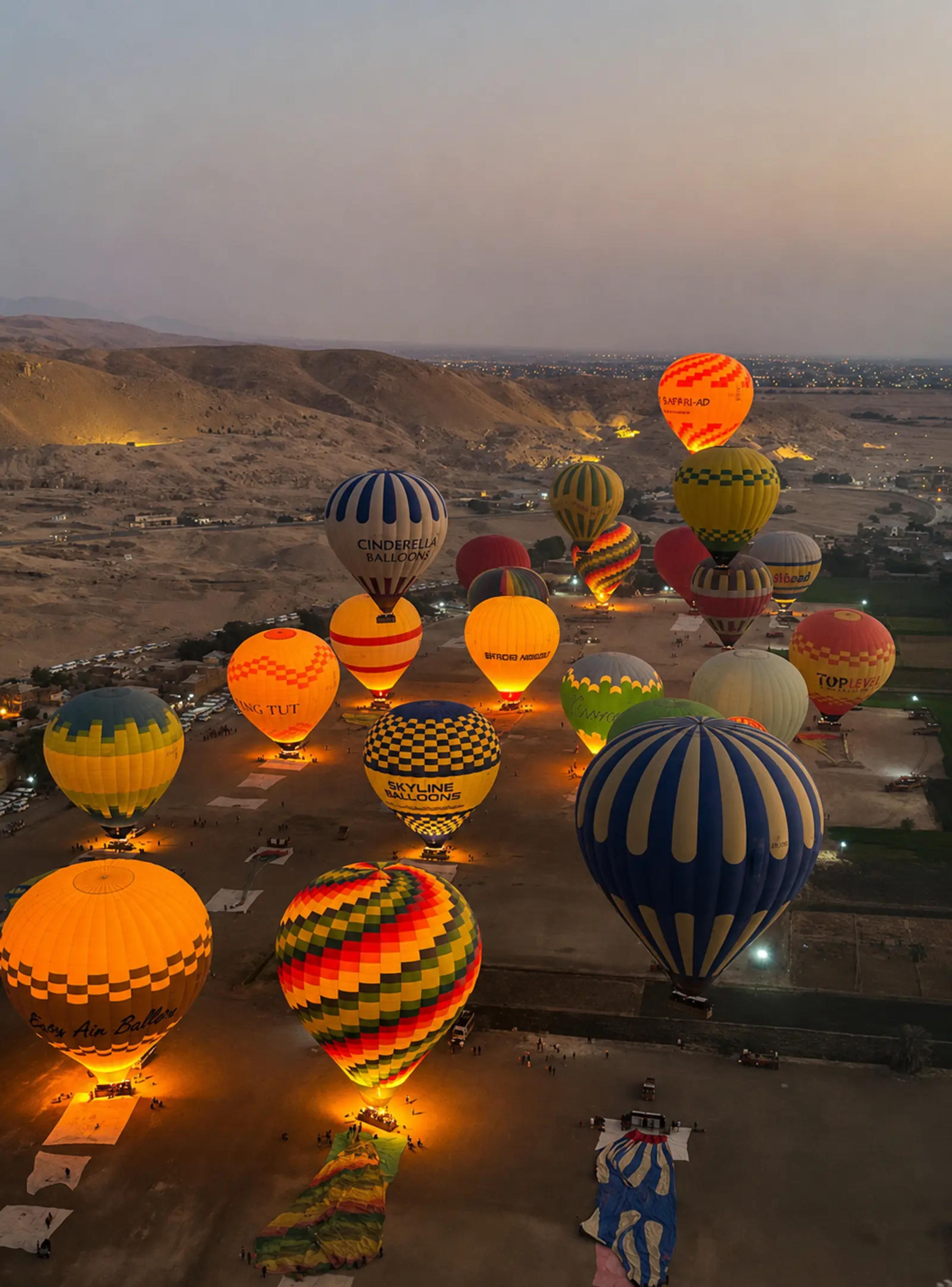
The West Bank is not a graveyard — it is a city of preparation, and I have spent seventeen years learning how to read it.
The West Bank: everything the ancient Egyptians built for the afterlife — Valley of the Kings, Hatshepsut's terraced mortuary temple, Colossi of Memnon, Valley of the Queens
The standard tourist visit misses: 3 tombs in 90 minutes on a bus. What this day is designed to do differently
The key variable: which tombs are open. Standard ticket = 3 tombs in Valley of the Kings. Extra tickets: Tutankhamun (KV62), Seti I (KV17), and the Tomb of Nefertari (QV66) each cost extra and require separate purchase
Pace: Valley of Kings first (before heat), then Hatshepsut, then lunch near Medinet Habu, afternoon at Colossi and optional extras
"Tutankhamun's tomb is famous because of what was found in it, not because of the paintings. If you want the finest New Kingdom art, I take you to Ramses VI first — the Book of Gates ceiling alone is worth the flight to Luxor."
What you'll see
Valley of the Kings: 65 royal tombs cut into the limestone cliffs; 3 included in the standard ticket with options to add Tutankhamun (KV62) and Seti I (KV17) at extra cost
KV9 Ramses VI — the Book of Gates and Book of Caverns ceiling; blue-ground astronomical text; among the most complete decoration in the valley
Hatshepsut Mortuary Temple (Deir el-Bahri) — three colonnaded terraces; the expedition to Punt reliefs showing the exchange of myrrh trees; erasure marks left by Thutmose III visible in the colonnade
Colossi of Memnon — twin seated statues of Amenhotep III, 18 metres tall; one cracked by earthquake and famous in antiquity for the "singing colossus" (thermal dawn sounds)
Valley of the Queens — 90 royal tombs; Nefertari's (QV66) contains the finest preserved New Kingdom painting in Egypt — extra ticket, 30-minute timed access
Deir el-Medina overview — the workers' village; rare insight into ordinary New Kingdom life; the community who built the royal tombs
Included / Not included
Included: Private licensed guide (Youssef), private vehicle with driver
, standard Valley of the Kings entry (3 tombs), Hatshepsut entry, Valley of the Queens standard entry, Colossi of Memnon (free), water throughout Not included: Gratuities, lunch, Tutankhamun KV62 extra ticket
, Seti I KV17 extra ticket, Nefertari QV66 extra ticket
, Deir el-Medina entry (if visited), Medinet Habu entry (if visited)
Difficulty & comfort
The Valley of the Kings involves significant uneven walking — the valley floor is loose gravel and the tomb entrances require descending steep ramps cut into limestone. Tomb interiors are dimly lit and can be warm even in winter. Hatshepsut Temple is fully exposed to the sun after 09:00 in summer — the cliff face radiates heat back and the terraces offer limited shade. I schedule this tour to leave the most open sites for early morning. Guests with significant mobility challenges should let me know in advance — most of the Valley is navigable but Nefertari's tomb (QV66) has narrow corridors. Sunhat, closed-toe shoes, and a light layer are essential.
Common questions
Q: Is Tutankhamun's tomb included in the standard ticket? A: No — Tutankhamun (KV62) requires a separate ticket, purchased at the valley entrance. I recommend adding it if you have not seen it, though I always explain: the tomb is famous because of the treasures found in it (now in Cairo's Egyptian Museum), not because of the paintings. For the finest New Kingdom painting still in the valley, Ramses VI (KV9) is in my view more impressive. The decision is yours to make when we are there.
Q: Can we see the Tomb of Nefertari? A: QV66 in the Valley of the Queens is available for visits with an extra ticket and a strict 30-minute access limit. It is the finest preserved New Kingdom tomb in Egypt — the Sistine Chapel comparison is overused but not wrong. I recommend it for guests with a serious interest in Pharaonic art. The ticket price is substantially higher than the valley standard and should be decided before we leave the hotel.
Q: How many tombs are included? A: The standard Valley of the Kings ticket covers 3 tombs of your choice from the open tombs that day (which tombs are open rotates to manage conservation). I will advise which to prioritise based on what is currently accessible and your interests.
Q: What happens if a tomb is closed on the day? A: Tomb access does change — conservation work, humidity levels, and seasonal rotation all affect which are open. I check in advance when possible but some changes are day-of. We will always have alternatives; I have not had a West Bank day ruined by a closed tomb in seventeen years of doing this.
Q: Can we include Medinet Habu and Deir el-Medina on the same day? A: It depends on pace and how much time you want in each place. A full West Bank including Valley of the Kings, Hatshepsut, Valley of the Queens, Medinet Habu, and Deir el-Medina is eight to ten hours minimum. I will always tell you honestly when a day is becoming too compressed to enjoy.
Q: Is lunch included? A: Lunch is not included in the tour fee but I arrange it at a local restaurant or traditional home near the West Bank.
The West Bank in full
The West Bank of Luxor is not a graveyard. That is the first correction I make, usually while crossing the Nile in the early morning, when the cliff face of the Theban massif is still in shadow and the limestone glows amber where the sun catches the top of the escarpment. The ancient Egyptians built the west side of the river for the preparation for death — the tombs of the pharaohs, the mortuary temples, the workers' village — but they built it as an active, inhabited precinct with its own community, its own economy, and its own theology. The Valley of the Kings was not hidden: it was guarded, maintained, and kept provisioned by a community of craftsmen whose descendants lived on the west bank for generations.
I have been guiding on the West Bank since 2009. The thing I try to convey in every visit is the relationship between the tombs and the mortuary temples — how they functioned as a paired system, with the physical body interred in the valley while the cult statue received offerings in the riverside temple. Hatshepsut's mortuary temple at Deir el-Bahri is exceptional for reasons that most visitors miss: the three terraces were designed to nestle against the cliff face, not to stand free in the landscape, and the natural amphitheatre of the cliffs focuses acoustic effects that the ancient Egyptians almost certainly understood. I find it useful to stand at the second terrace with the valley behind me and explain what the priest would have experienced approaching from the river.
Reading a tomb correctly
The standard Valley of the Kings visit gives a guest three tombs on the standard ticket, plus options to add Tutankhamun (KV62), Seti I (KV17), and Nefertari (QV66) at additional cost. The question of which three standard tombs to visit is one I take seriously. Tutankhamun's tomb is famous because of what was found in it — the gold funerary equipment, the mummy — not because of the paintings, which are modest by Valley standards. If I have a guest who wants the finest New Kingdom painting inside the valley itself, I take them to Ramses VI (KV9) first: the Book of Gates and the Book of Caverns ceiling, rendered in blue against a night-black ground, with astronomical texts that the ancient astronomers used to track the hours of the night. That ceiling tells you more about Egyptian cosmology than any museum.
The selection of which tombs to open, and when, is managed by the Egyptian Ministry of Tourism. Some tombs rotate in and out of access seasonally; others are undergoing conservation. I check the current access conditions before every West Bank day and adjust accordingly. The goal is always to see the best-preserved painting in the best morning light — which in the valley means entering as early as the ticket booths allow, before the temperature inside the tombs rises and before the groups from the cruise ships begin their queue at the entrance road.
Hatshepsut's temple and what the erasure means
At Hatshepsut's mortuary temple at Deir el-Bahri, the most interesting detail is absence. Thutmose III — her stepson and co-regent, who ruled after her death — ordered systematic erasure of her name and image from the reliefs. His stonemasons worked methodically across the three terraces, chiselling out the cartouches and replacing female pronouns with male ones. The erasure is visible in multiple places: look for rectangular patches in the colonnade where the surface has been worked smooth, or for figures where the face has been cut away and a different one superimposed. For a long time Egyptologists interpreted this as an attempt to erase her memory. The current reading is more nuanced — the timing of the erasure suggests it happened near the end of Thutmose III's own reign, possibly related to succession anxieties, and was not as systematic as it first appeared. She survived in many of her inscriptions. The Punt expedition reliefs — showing the trading mission to the land of Punt, wherever that was, with myrrh trees transplanted into Egyptian soil — survived entirely, and they remain among the most vivid narrative reliefs in Egyptian monumental art.
The Colossi, the workers, and the afternoon
The Colossi of Memnon stand at the entrance to the West Bank agricultural plain, marking the original position of Amenhotep III's mortuary temple — the largest ever built in Egypt, now almost entirely gone, robbed out for building material over millennia. The two seated figures, each eighteen metres tall and cut from single blocks of quartzite sandstone quarried at El-Gabal el-Ahmar near Cairo and transported three hundred kilometres upstream, are familiar from photographs but strange in person: their scale requires standing close to register correctly. The crack in the northern colossus, caused by an ancient earthquake, allowed thermal dawn sounds — the stone expanding in early morning heat — that Greek and Roman visitors in the Ptolemaic period called the "singing" of Memnon. The crack was later repaired by the Emperor Septimius Severus, and the singing stopped.
Deir el-Medina — the workers' village visible from the road between Hatshepsut's temple and the Valley of the Queens — is one of the most informative sites on the West Bank for guests who want to understand Egyptian society rather than only pharaonic monuments. The community of craftsmen who built and decorated the royal tombs lived here for generations. Their own tombs, cut into the hillside above the village, contain painting that is as fine as anything in the royal valley — and they are almost always empty of other visitors. If time and interest allow, I include the village in the afternoon section of the day. The legal records from Deir el-Medina are among the richest source materials for ancient Egyptian daily life: strikes, court cases, letters, medical prescriptions, and receipts for everything from grain to cosmetics.
Hour by hour
Cross to West Bank via ferry or bridge; approach from desert road
Photo cue: —
Brief stop — best morning light; context before Valley entry
Photo cue: Wide: two colossi against pale dawn sky
Enter with first group; 3 tombs standard (Ramses VI KV9 + 2 chosen with guest)
Photo cue: Wide: valley cliff entrance; Detail: tomb ceiling star map
Extra ticket; I explain why the small scale is historically significant
Photo cue: Detail: golden shrine painted wall panels
West Bank road past the Workers' Village (Deir el-Medina on horizon)
Photo cue: —
Three terraces; Punt expedition reliefs; Chapel of Anubis; erasure marks
Photo cue: Wide: terraces against cliff face; Detail: Punt reliefs
Context for Nefertari's tomb; walk the approach (QV66 extra ticket if desired)
Photo cue: Wide: valley entrance, quieter than VOK
Extra ticket; 30-minute access limit; finest New Kingdom painting in existence
Photo cue: Detail: Nefertari with Thoth in blue faience palette
Photo cue: —
Ramses III mortuary temple; Sea Peoples reliefs if specialist interest present
Photo cue: Wide: first pylon with battle reliefs
Workers' village;
Photo cue: Detail: workers' tomb interior
—
Photo cue: —