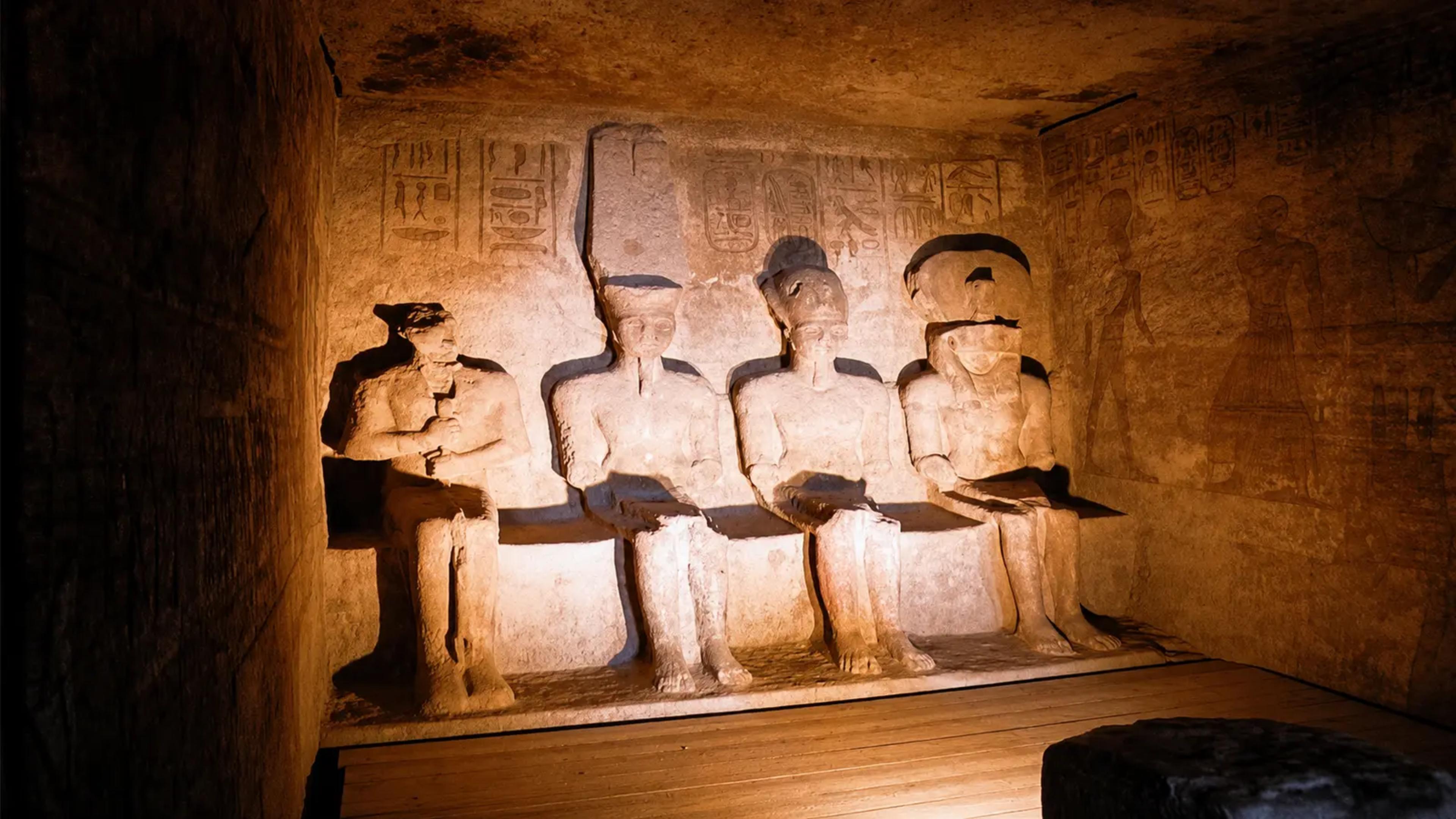
For guests who want to go further than the standard sites — this is the day I find most satisfying to guide.
Target persona: Egyptology enthusiasts, retired professors, documentary researchers, guests who have already done the standard circuit
Standard sites are standard for a reason — but Luxor has more. This day is built for people who have seen Karnak and the Valley of the Kings and want the layer underneath
Core sites: Medinet Habu (Battle of the Sea Peoples, the most detailed military narrative in Egyptian art), Deir el-Medina (the workers who built the Valley), Tombs of the Nobles (painted in a completely different register from royal tombs), and an optional deep dive at whichever royal tomb is currently open that merits extended time
"Medinet Habu is where I take guests who have run out of superlatives for Karnak. Ramses III carved his entire military biography on stone that has barely faded in 3,200 years."
Note: this tour is flexible by design — I build it around what the guest genuinely wants to understand, not a fixed route
What you'll see
Tombs of the Nobles — the painted tombs of Theban officials and administrators (Rekhmire, Sennefer, Menna, Nakht) showing vivid New Kingdom daily life in red, yellow, and green; a visual register entirely different from royal tombs
Deir el-Medina — the walled village that housed the artisans who built the royal tombs; ancient ostraca written by workers; the small painted tombs of the craftsmen themselves
Medinet Habu — Ramses III's mortuary temple; the most detailed record of the Sea Peoples migration-invasion (c. 1177 BC); the harem conspiracy text carved in stone; an extraordinary state of preservation
Extended Valley of the Kings — one royal tomb in depth without time pressure; possible choices: KV17 Seti I (open irregularly), KV2 Ramses IV, KV14 Tausert and Setnakht
Optional erasure analysis at Hatshepsut Temple — reading the physical evidence of damnatio memoriae in stone
Included / Not included
Included: Private licensed guide (Youssef), private vehicle with driver
, Tombs of the Nobles entry
, Deir el-Medina entry, Medinet Habu entry, water throughout Not included: Gratuities, lunch, Valley of the Kings ticket (if included), Seti I KV17 extra ticket if chosen, Hatshepsut Temple entry (if revisited)
Difficulty & comfort
The Specialist Day is the most active itinerary I offer. The Nobles' Tombs require crouching in low-ceilinged corridors. Deir el-Medina is on a hillside path. Medinet Habu involves 2–3 km walking on large stone blocks. I rate this Active because the pace is set by genuine engagement — we stop and read things closely, we look up and down, we go into spaces that are not always wide or lit. A base level of physical comfort walking unevenly on stone is necessary. This is not the tour for guests who prefer to stay on the main paths.
Common questions
Q: Can we focus the day on one area rather than covering multiple sites? A: Yes — the Specialist Day is the most flexible tour I offer. If you want to spend the entire day at Medinet Habu and Deir el-Medina, we do that. If you want the Nobles' Tombs and a single royal tomb in depth, we do that. Tell me before we start what you most want to understand.
Q: Is prior knowledge of Egyptology required? A: No. I explain everything from the ground up, regardless of where you are starting from. What distinguishes this tour from the standard circuit is not the complexity of the content but the depth of engagement and the sites we choose. I have guided archaeologists and guests who came in knowing nothing; both usually end the day satisfied.
Q: Is Deir el-Medina connected to any archaeological missions you have worked with? A:
Q: Can the tour include Medinet Habu and the Valley of the Kings on the same day? A: Yes, with the understanding that the Valley visit will be one tomb in depth rather than three tombs in quick succession. I prefer depth over coverage on this particular day.
Q: What is your guide license number? A:
Q: Is this tour suitable for academic researchers or documentary crews? A: I have worked with both. For documentary crews, logistics around filming permissions are separate from the guide arrangement. For academic guests, I am happy to discuss any specific sites or textual questions in advance.
What a specialist day is
There is a version of Luxor that most visitors never reach. Not because it is hidden — the sites are on the same maps, accessible to the same ticket-holders — but because the standard tour circuit does not stop at Medinet Habu, does not enter the workers' tombs at Deir el-Medina, does not stand in front of the Karnak cachette room and discuss what the priests buried in the courtyard floor when Alexander the Great arrived. A specialist day is structured around a single thread of inquiry and follows it across multiple sites, at whatever depth that inquiry requires.
I have been designing specialist days for academic guests, architects, Egyptologists in training, and deeply prepared independent travellers since the early years of my practice. The itinerary is set in consultation before we arrive in Luxor. Possible threads include: the development of Egyptian funerary theology across three periods (Old, Middle, New Kingdom); the relationship between temple architecture and the solar calendar; the evidence for female pharaonic authority from Hatshepsut to Tausret; the technical question of how the ancient Egyptians managed pigment stability in tomb painting over three thousand years; or the cross-cultural contact visible in the Sea Peoples reliefs at Medinet Habu. These are not topics for the corridor of a tour bus.
Sites that a specialist day reaches
Medinet Habu — the mortuary temple of Ramses III — contains the most complete record of the Sea Peoples invasions in Egyptian art. The first pylon shows Ramses III in the conventional pose of a pharaoh smiting enemies, but the enemies are identifiable: the feathered headdresses, the ship designs, and the weaponry match descriptions from Aegean Bronze Age records. Whether the Sea Peoples were refugees from the collapse of the Mycenaean world or a different population movement is still contested. The reliefs let you stand inside that contested question. I know of no other site in Egypt where the geopolitical anxiety of the Bronze Age collapse is this legible.
The artisans' tombs at Deir el-Medina — cut by the craftsmen who built the royal valley tombs, for their own use — contain some of the finest painting in Egypt. The tomb of Sennedem (TT1) has a chamber ceiling decorated with the Book of the Gates that is as well preserved as anything in the Valley of the Kings proper, and it is rarely visited. The workers' village below it, excavated over decades by Italian and French missions, produced the richest documentary record of ordinary Egyptian life ever found: letters, legal complaints, work schedules, medical receipts, love poetry. The papyri are in Cairo but the physical spaces remain, and walking the village with that documentary context is a qualitatively different experience from walking the royal temples.
The Karnak cachette room — the court where priests buried more than seventeen thousand bronze and stone statues in the late Ptolemaic period, found in 1904 — is usually walked through without pause. For a guest interested in the transition from pharaonic to Ptolemaic religious practice, it is a critical site. The decision to bury the statues rather than melt them or reuse them tells a story about how the priests understood sacred objects and their relationship to divine presence. I carry books of the relevant scholarship and we discuss it at the site, which is the only way I know to do it justice.
The preparation that makes a specialist day work
A specialist day requires preparation on both sides. I ask guests to send me their specific questions or research interests at least a week before the visit, so I can prepare the relevant bibliography and plan the itinerary around the sites that address those questions most directly. In return, I can go to places and engage with material that a standard tour cannot approach — the Luxor Museum's New Kingdom gallery at length, the conservation laboratory when access is available through my contacts at the Council of Antiquities, the specific tomb sections that illuminate a particular iconographic question.
The day ends when the questions run out, which in my experience is usually around four in the afternoon. I have had specialist days that ended at two with the guest entirely satisfied, and others that ran until the sites closed at sunset. The pace is determined by the inquiry, not by a schedule. That is the essential difference between this and any other tour format I offer.
Hour by hour
West Bank crossing; early start for the Tombs of the Nobles before it gets busy
Photo cue: —
Painted tombs of Theban officials; New Kingdom daily life scenes (hunting, farming, banquets)
Photo cue: Detail: agricultural scene with figures and colour in situ
Workers' village and its own small tombs; ancient graffiti; ostraca context
Photo cue: Wide: village layout from approach path
Ramses III mortuary temple; Sea Peoples battle reliefs on first and second pylons; harem conspiracy inscription; calendar of festival offerings
Photo cue: Wide: first pylon with reliefs; Detail: Sea Peoples naval battle
Photo cue: —
One chosen tomb in depth — extended time without the group tour pressure
Photo cue: Chosen tomb ceiling or deep-chamber detail
Optional: return to Deir el-Bahri specifically for the erasure marks on the colonnade — links to the hatshepsut-erased journal article
Photo cue: Close-up erasure mark vs intact adjacent relief
—
Photo cue: —