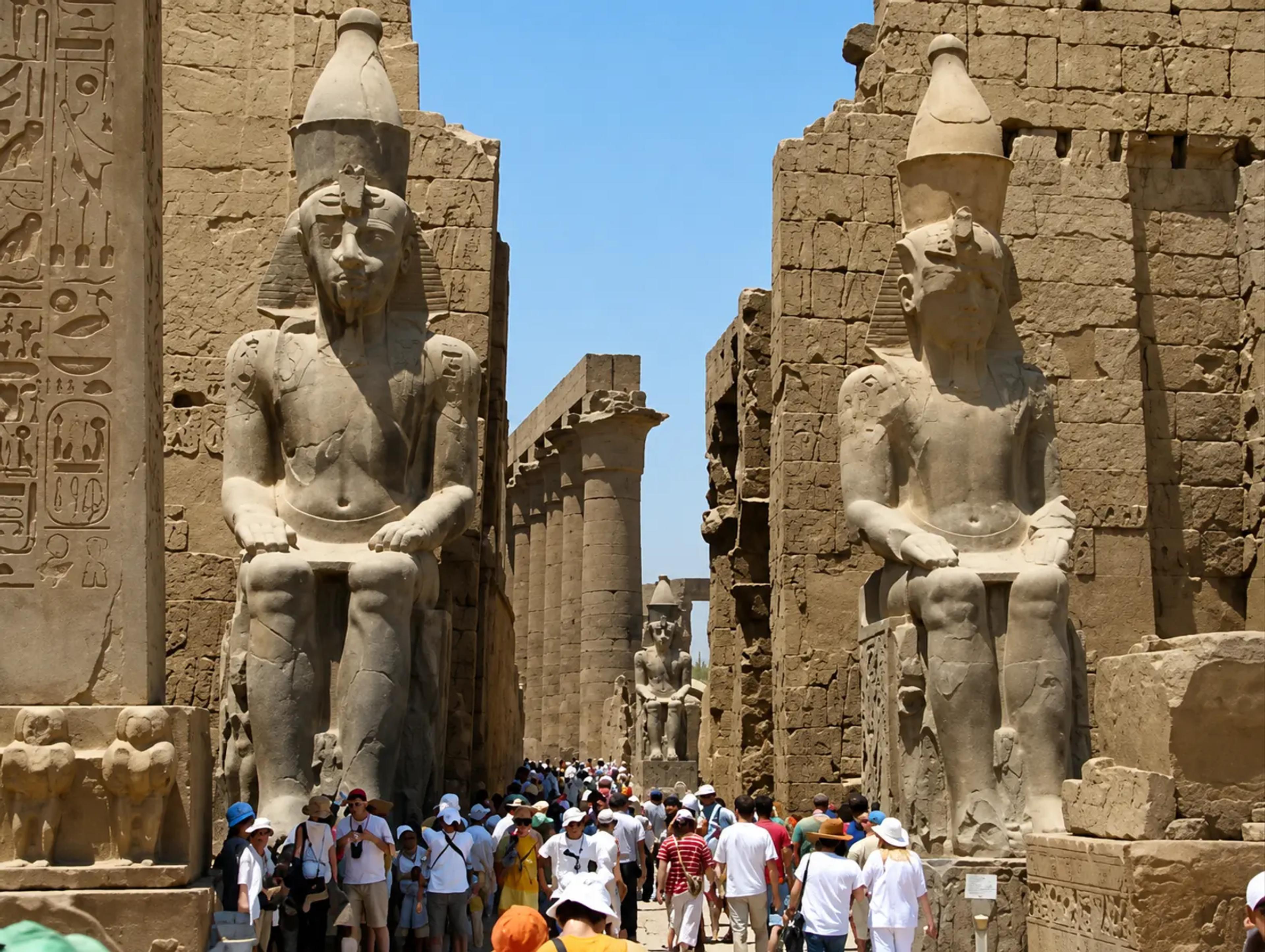
I have been arriving at Karnak before six in the morning for seventeen years. Nothing compares to the Hypostyle Hall in the first hour of light.
East Bank is the living city of ancient Luxor — the temples were not ruins but active sacred precincts
Karnak: the largest religious structure ever built; 2,000 years of continuous construction by more than 30 pharaohs
Key tension: most visitors arrive mid-morning on buses; arriving at dawn transforms the experience entirely
Luxor Temple: a different register — intimate, vertical, built for the festival procession along the Avenue of Sphinxes
"The light at Karnak changes every ten minutes in the first hour after sunrise. By the time the tour buses arrive, the shadows have already flattened. I time every East Bank day around that."
Afternoon structure: Luxor Temple for the afternoon light, which comes in low from the desert side and rakes across the face of Ramses II
Pace note: not a march through corridors — I stop where something is actually worth stopping; we skip the gift-shop circuit
What you'll see
The Hypostyle Hall — 134 sandstone columns up to 21 metres tall; reliefs showing Seti I and Ramses II
The two obelisks of Hatshepsut at Karnak — one standing at 29 metres; inscriptions she wrapped in electrum so Thutmose III could not efface them
The Sacred Lake — ritual purification pool; the largest in Egypt; dawn reflections
Akhenaten's talatat blocks — reassembled sections of the dismantled Aten temple built inside Karnak before the pharaoh moved to Amarna
The ram-headed sphinxes of the processional way — each ram cradles a small figure of Ramses II between its paws
Luxor Temple's colonnade of Amenhotep III — 14 papyrus-bud columns forming a processional corridor; festival reliefs not found at Karnak
The Roman fresco layer at Luxor Temple — early Christian and later Roman images painted over the pharaonic reliefs in the innermost sanctuary; rarely explained to visitors
Included / Not included
Included: Private licensed guide (Youssef), private vehicle with driver
, entry tickets to Karnak and Luxor Temple, bottled water throughout Not included: Gratuities, lunch, optional Karnak Open Air Museum ticket, optional Luxor Museum entry, any personal purchases
Difficulty & comfort
This tour involves 4–5 km of walking across two sites, mostly on uneven stone floors and sandy pathways. The Hypostyle Hall is partially shaded; the Sacred Lake area is open to the sun. In summer (May–September) the heat by 10:00 is serious — I will shorten the exterior portions and extend interior time accordingly. Guests with mobility concerns should note that Karnak has no escalators or lifts; most corridors are wide and navigable with a cane, but the outermost courts are sandy ground. Proper footwear (closed-toe, flat sole) is essential — sandals with no back strap are not safe on the stone threshold steps. Sunhat and a light layer for the shaded halls are recommended year-round.
Common questions
Q: Why do we start at 06:00? Can we come a bit later? A: Karnak is extraordinary before the group tours arrive, and genuinely difficult to move through after 09:00 in high season. I have been starting here at dawn for seventeen years and the difference is not subtle. An hour of quiet in the Hypostyle Hall is worth an extra hour of sleep. That said, I am flexible — if you are travelling with children or have specific reasons to start later, we can adjust.
Q: Is the Tutankhamun tomb included? A: This East Bank day does not include the Valley of the Kings — that is the West Bank. Tutankhamun's tomb (KV62) requires a separate ticket and is covered in the West Bank Day tour.
Q: We have visited Karnak before. Will this still feel worthwhile? A: Repeat visitors are some of the most rewarding guests I work with. I do not follow a standard route. For guests who have already seen the main halls I go into the Festival Hall of Thutmose III, the Ptah chapel, the sections most guides skip. Tell me what you have already seen and I will plan accordingly.
Q: Can we visit Luxor Museum on the same day? A: Yes, it works well as a midday option when the outdoor sites are at their hottest. Allow 90 minutes. The New Kingdom mummification artifacts and the cache of Karnak statuary are exceptional.
Q: How much walking is involved? A: Karnak alone is roughly 3 km if we walk the main route. Luxor Temple adds another 1.5 km. The ground is largely flat but stone and uneven in places. I always pace to my guests — there is no forced march.
Q: Is this suitable for children? A: Yes, with some preparation. I recommend the family-day tour if children are the primary guests, as it is structured around shorter attention spans and more interactive story-telling. The East Bank Day works well for children aged 10+ who have an interest in history.
Q: What is the guide's license number? A:
What the East Bank actually is
Most visitors arrive in Luxor with a mental image of temples as isolated monuments — silent ruins in a desert. The East Bank corrects that immediately. Karnak was never a ruin during its active life. For two thousand years it was the beating heart of Egyptian state religion, expanded by every pharaoh who wanted to leave a mark on the physical world. The scale of the Hypostyle Hall — one hundred and thirty-four columns, the tallest reaching twenty-one metres — is not a fact that translates easily to photographs. You have to walk into it at six in the morning, when the light is still pink and the tour buses are still loading at the hotel, to understand what the ancient builders were attempting.
I have been guiding at Karnak since 2009. The thing that changes most in seventeen years is not the site itself — the reliefs, the obelisks, the sacred lake — but the visitors' relationship to it. People who arrive with academic preparation absorb a different Karnak than those who come without it. My job is to provide that preparation efficiently, in the time we have before the crowds arrive. So the morning structure of this day is deliberate: we enter the complex before six, we move slowly through the spaces where the light is doing something useful, and we leave the Hypostyle Hall before nine, when the shadows flatten and the groups from the Nile cruise ships begin their march.
The two obelisks of Hatshepsut
One of the most instructive conversations at Karnak happens at the obelisks of Hatshepsut. She raised two pink granite obelisks — each carved from a single stone at the Aswan quarry, floated north on the Nile, and erected inside the complex — to mark her jubilee festival. One stands. One lies. The standing obelisk, at twenty-nine metres, is one of the tallest in Egypt. Hatshepsut wrapped the electrum tips so that the sunrise would catch them first across the whole East Bank. She also ordered that the lower shafts be encased in stone — not to hide the inscriptions, as a later pharaoh would attempt, but to protect them from exactly that kind of erasure.
Thutmose III — her stepson, co-regent, and eventual successor — did attempt to efface her name and image from Karnak after her death. He was thorough but not entirely successful. The encased lower shaft survived. Walk around the obelisk at seven in the morning and you can still read the original dedication text. I find that the story of Hatshepsut and Thutmose III tells visitors more about ancient Egyptian politics than any number of facts about dynasties and dates.
The Avenue of Sphinxes and Luxor Temple
The Avenue of Sphinxes — three kilometres of ram-headed sphinxes connecting Karnak to Luxor Temple — was the processional road of the Opet Festival, the annual event that renewed the pharaoh's divine authority. For most of Luxor's modern history the avenue was buried under the city. The sphinxes you see today were excavated in stages over decades, the most recent work completed in 2021. Walking any portion of it gives a useful sense of the original urban layout — not a temple in a desert, but a sacred district embedded in a living city.
Luxor Temple is a different emotional register from Karnak. Where Karnak accumulated additions from thirty pharaohs over two thousand years, Luxor Temple was built primarily by Amenhotep III and completed by Ramses II in a shorter, more coherent campaign. The colonnade of Amenhotep III — fourteen papyrus-bud columns, eighteen metres tall — gives the temple an elegance that Karnak's accumulated density does not attempt. The inner sanctuary, where the cult statue of Amun was kept, was later converted to a Roman chapel. The legionnaire's fresco — Roman painting directly over pharaonic relief, the soldiers' hands visible at the bottom of the composition — is one of those details that most guides walk past. I stop there. It says something that a guidebook cannot easily convey about how history layers on itself without regard for the previous occupants.
What I carry into every East Bank day
I started my career in Luxor working for large tourism companies, moving groups through sites on a schedule. That background is useful — I know exactly how long every section of Karnak takes, what the bottle-neck moments are in high season, and how to read the crowd patterns from the ticket booths. The private guiding I have done for the past several years lets me do something that group work does not: pause where something is worth pausing, and skip what is not worth your time. The gift-shop circuit at the exit of Karnak is not worth your time. The relief showing Seti I presenting offerings to Amun, in the hypostyle's northern row, often is. I know which details are legible in the morning light at this time of year, and I plan accordingly.
The East Bank day runs eight to nine hours including travel, two temple visits, and a proper lunch. I end every day with the same question I ask internally at the beginning: did we see anything that required being here, with this person, at this particular hour? When the answer is yes, the day has worked.
Hour by hour
Private vehicle with driver; cold water and brief route overview
Photo cue: —
Enter before crowds; walk the processional way of ram-headed sphinxes
Photo cue: Wide: ram sphinxes receding into dawn haze
134 columns; reading the relief inscriptions; light through stone gaps
Photo cue: Detail: carved hieroglyphs lit by raking morning light
Scarab statue circuit; solar barque context; rare quiet moment
Photo cue: Reflection of the Hypostyle pylon in still water
The dismantled blocks; what the "heretic" pharaoh built here first
Photo cue: Detail: reassembled talatat blocks
Obelisks of Hatshepsut (one standing, one fallen); height comparison
Photo cue: Wide-to-detail: full obelisk height + inscription close
East bank café; short rest before midday
Photo cue: —
Avenue of Sphinxes; Ramses II colossi and obelisk (twin now in Paris)
Photo cue: Golden-hour-adjacent: low southwest light on red granite
Colonnade of Amenhotep III; Roman fresco overlay (often missed)
Photo cue: Detail: Roman plaster over pharaonic relief
Photo cue: —
Luxor Museum (if time/interest) — mummies and New Kingdom artifacts
Photo cue: —
—
Photo cue: —