What it is
The Valley of the Queens (Ta-Set-Neferu — "the place of beauty") is a limestone wadi on the west bank of the Nile at Luxor, located approximately 1.5 kilometres south of the Valley of the Kings. The valley served as the burial ground for the queens, princes, and princesses of the New Kingdom, as well as some non-royal officials. More than 90 tombs have been identified, numbered QV1 through QV92. The most significant tomb in the valley — and one of the most celebrated painted spaces in ancient Egypt — is QV66, the tomb of Nefertari, Great Royal Wife of Ramses II. Access to QV66 is strictly controlled and requires a separate, considerably more expensive ticket. The valley itself is less visited than the Valley of the Kings, which makes timing easier and the experience quieter.
Why it matters historically
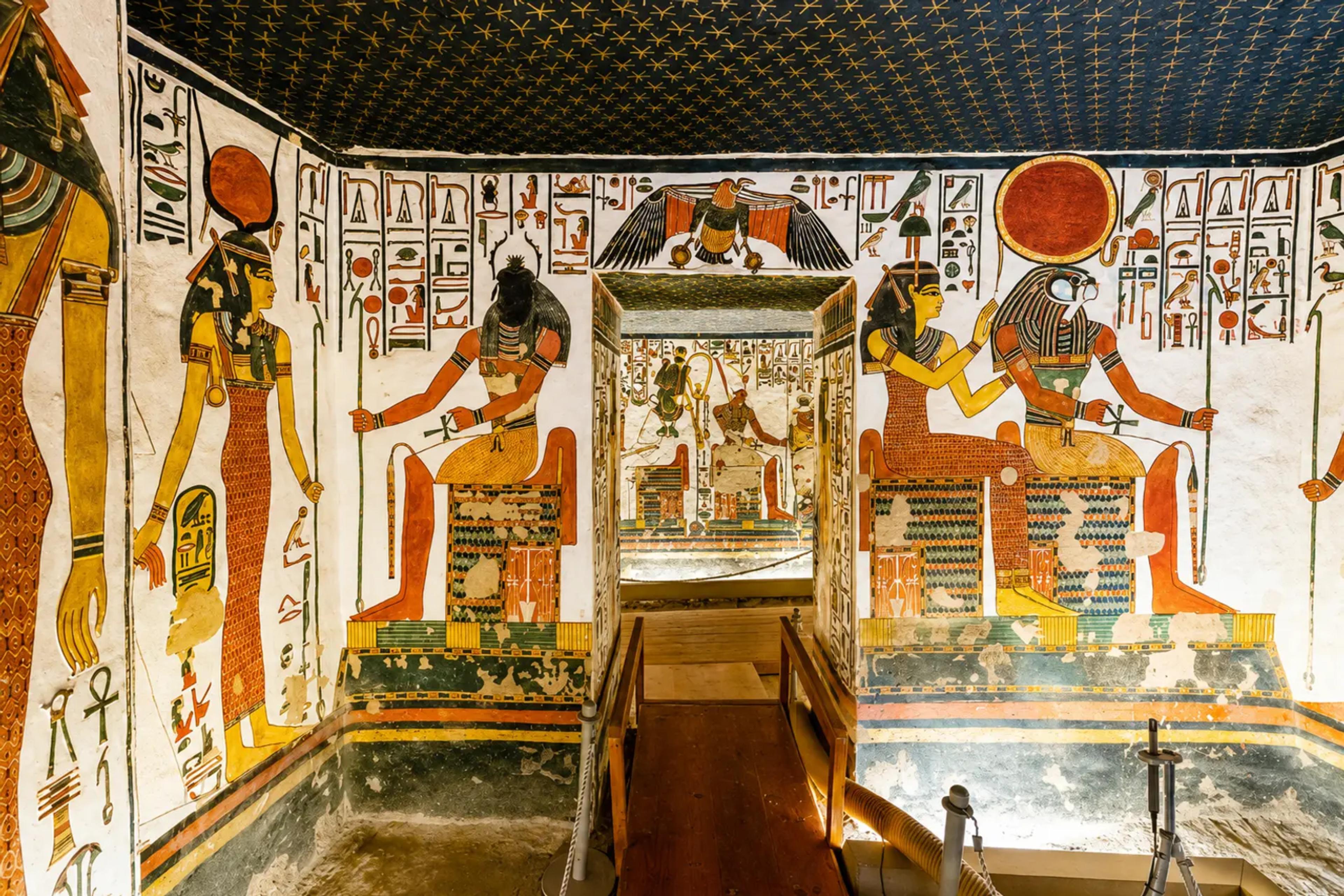
Nefertari's tomb (QV66) — executed in raised relief with original polychrome paint surviving at remarkable levels; the finest painted tomb in Egypt; the wall programme follows the Book of the Dead and the Book of Gates; the ceiling of the burial chamber is painted as a night sky; preservation of the pigment — including the vivid cobalt blue and saffron yellow — is attributed to the exceptional dryness of the limestone and the tomb's long-sealed condition. Access is limited to 150 visitors per day in groups of no more than 10, with a maximum 30-minute window inside.
Queens of the 19th and 20th Dynasties — the valley is primarily a New Kingdom royal necropolis; the tombs of Tyti (QV52), Nefertari (QV66), and the princes (QV55 Amunherkhepshef, QV43 Sethherkhepshef) show a range of artistic quality from superb to utilitarian; the contrast helps Egyptologists understand the hierarchy of artisan allocation
Princes' tombs — several sons of Ramses III are buried here rather than in the Valley of the Kings; QV55 (Prince Amunherkhepshef) retains exceptionally detailed figures with fine paint; the burial chamber includes a foetus in a calcite box — one of the most poignant archaeological discoveries in the valley
Conservation legacy — the Getty Conservation Institute worked at QV66 from 1986 to 1992 to stabilize and document the wall paintings; the current ticketing and access system descends directly from that project's recommendation to limit visitation; the tomb's condition today is substantially better than it was before the project
The "place of beauty" etymology — Ta-Set-Neferu may refer to Hathor, "lady of beauty," the goddess associated with the afterlife; the name distinguishes this valley as a site of active royal female commemoration rather than just burial
What to look for
QV66 — Nefertari's tomb — the burial chamber ceiling stars; the figures of Nefertari in white linen offering to the gods; the colour density on the east wall showing the queen's journey through the underworld; examine the raised relief technique closely — each line is both carved and painted, not just painted.
QV55 — Prince Amunherkhepshef — the tomb of the young prince, son of Ramses III, who died before succeeding his father; the figure of the prince in youth — white kilt, side-lock of youth — is among the most naturalistic youth portraits in royal tombs; the foetus in a calcite box is displayed in context; the colours here are vivid and the tomb is often quiet.
QV52 — Queen Tyti — wife of Ramses III; smaller tomb but complete programme; the face of Tyti on the south wall is one of the most delicate portraits in the New Kingdom; the damaged areas allow comparison between the intact original paint and the underlying limestone
The valley approach road — the drive from the ticket office follows a wadi floor flanked by white limestone cliffs; the silence and isolation is stronger here than at the Valley of the Kings; at dawn the cliffs take on a chalk-blue colour before the sun reaches them
The comparative quality gradient — visiting two or three tombs here in sequence allows direct observation of the artisan hierarchy; a top-tier royal tomb like QV66 and a more workmanlike prince's tomb show measurably different preparation, relief quality, and colour application — this is an observation I regularly stop to discuss with guests
Practical visiting block
Best time to visit: 07:00–09:00 before the valley warms. QV66 requires pre-booking; same-day tickets are rarely available on high-season days.
Tickets & fees: Standard valley ticket includes access to a rotation of open tombs (not QV66). QV66 extra ticket:
Accessibility: The valley floor is gravel and compact. QV66's entrance corridor involves a descent on steep limestone steps with a handrail — visitors with mobility concerns should assess this carefully. The inner burial chamber requires ducking through the final threshold. Other tombs in the standard rotation are more accessible.
Walking distance: Ticket office to QV66: approximately 300 metres on flat gravel. Total walking with 3 tombs: 1–2 km.
Restrooms: Available near the ticket area at the valley entrance.
Tours that include this site
Specialist Day → /tours/specialist-day — extended time at QV66 without the time pressure of a standard west bank day; includes comparison with a prince's tomb
West Bank Day → /tours/west-bank-day — QV66 as an optional add-on; standard ticket included; the extra ticket discussed at booking
Related sites
Valley of the Kings → /luxor/valley-of-the-kings — the parallel valley for pharaohs on the same mountain complex; Ramses II (whose wife Nefertari is buried in QV66) is in KV7
Hatshepsut Temple → /luxor/hatshepsut-temple — 1.5 km north across the Deir el-Bahri basin; the same west bank landscape; visible from the valley approach road in the direction of El-Qurn
Medinet Habu → /luxor/medinet-habu — Ramses III's mortuary temple; his sons buried in the Valley of the Queens