What it is
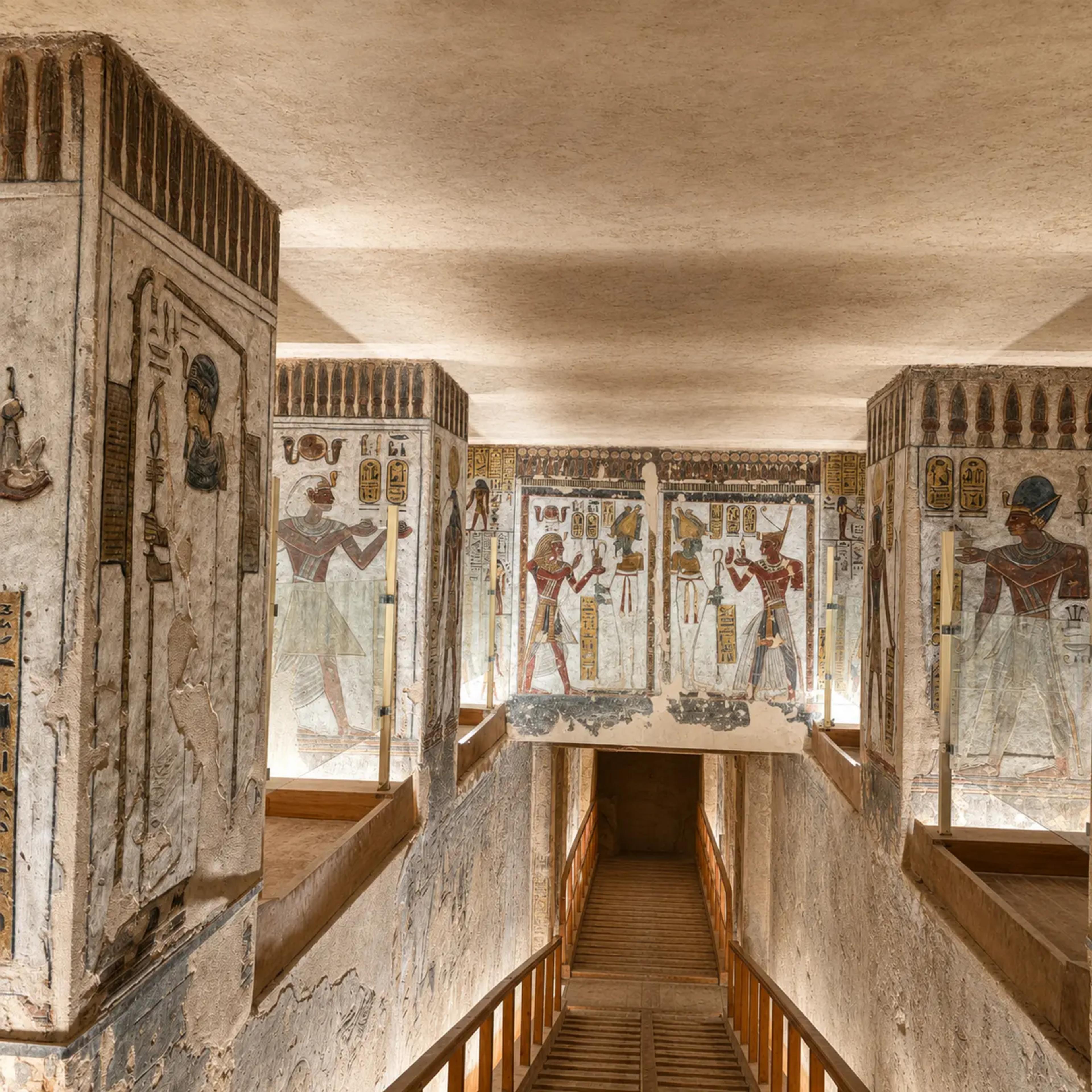
The Valley of the Kings (Wadi Biban el-Muluk) is a dry limestone wadi on the west bank of the Nile at Luxor, used as the royal necropolis for the pharaohs of the New Kingdom — a period spanning roughly 1550–1070 BC. The valley contains 65 known tombs (designated KV1 through KV65, with additional tombs discovered in KV64 and KV65 in the 21st century), carved into the limestone cliffs and decorated with religious texts designed to guide the deceased through the underworld. The valley was chosen for its geological stability, its hidden location relative to the Nile plain, and its proximity to the pyramid-shaped natural peak El-Qurn, considered sacred to the goddess Meretseger. Unlike Karnak and Luxor Temple, the Valley of the Kings was never a place of public worship — it was secret, protected, and strictly ceremonial.
Why it matters historically
The shift from pyramids to hidden tombs — the New Kingdom pharaohs moved from the visible pyramid complexes of the Old and Middle Kingdoms to the concealed rock-cut tombs of the Valley; the change reflects both practical security concerns (tomb robbery) and evolving religious cosmology
The Book of Gates and Book of the Dead — Valley tomb walls are not historical narratives but religious atlases of the underworld; the Book of Gates (KV9, KV17), Book of Caverns, and Amduat guide the deceased sun through 12 hours of the night; the astronomical ceiling of KV9 (Ramses VI) maps the sky over the underworld
Tutankhamun's discovery (1922) — Howard Carter's discovery of KV62 changed modern understanding of New Kingdom material culture; the tomb was unrobbed; the contents (now largely in the Grand Egyptian Museum, Cairo) represent the only substantially complete royal burial assemblage known
The tomb robbery papyri — extensive ancient records survive of the organized robbery of royal tombs during the 20th Dynasty; the bodies of most pharaohs were rewrapped and cached in two hidden caches (Deir el-Bahari cache and KV35) by priests trying to protect them from further looting
KV17 — Seti I — considered to have the finest relief decoration in the valley; carved in raised relief with vivid paint; accessible only intermittently due to conservation concerns;
What to look for
KV9 — Ramses VI — the longest tomb in the standard ticket rotation; the Book of Caverns and Book of Gates cover the walls; the astronomical ceiling is the finest in the valley. Photo cue: entrance corridor lit naturally at dawn; ceiling star-map detail with artificial light.
KV62 — Tutankhamun — small, simply decorated by royal standards; the significance is historical not aesthetic; the burial chamber's north wall shows the Opening of the Mouth ceremony; the mummy of Tutankhamun remains in the tomb. Photo cue: burial chamber detail; the only royal mummy still in the valley.
The geological setting — stand at the valley junction and look up: the pyramid-shaped El-Qurn is visible above; the valley's walled limestone sides create complete silence at dawn. Photo cue: cliff walls framing the valley approach road.
KV14 — Tausert and Setnakht — one of the longest tombs, begun for Queen Tausert and usurped by Setnakht; includes very large format reliefs; rarely crowded compared to KV9. Photo cue: large antechamber with double-register reliefs.
The archaeology of robbery — look for the ceiling marks where ancient robbers burned torches (soot deposits); the narrow corridors are sized to prevent removing large items, yet most tombs were emptied within generations.
Practical visiting block
Best time to visit: 06:00–09:00 before the cruise ship groups arrive. The valley access road is largely open; the tombs themselves are always the same temperature regardless of outside time.
Tickets & fees: Standard ticket: 3 tombs of your choice from the open rotation.
Tutankhamun KV62 extra ticket
Seti I KV17 extra ticket (when open)
Accessibility: Valley floor is gravel and manageable on foot. Tomb entrances involve descending ramps cut into limestone; gradients vary from gentle to steep. The descent to some inner chambers is narrow and requires ducking. Not suitable for guests with significant mobility limitations; most basic tombs are navigable with care.
Walking distance: Parking/visitor centre to furthest main tomb (KV9): approximately 700 metres. Total walking with 3 tombs: 2–3 km.
Restrooms: Available near the visitor centre/parking area.
Tours that include this site
West Bank Day → /tours/west-bank-day — 3 standard tombs in morning cool; cornerstone west bank visit
Two-Day Luxor → /tours/two-day-luxor — Day 2 morning; the Valley as the first west bank stop before Hatshepsut
Specialist Day → /tours/specialist-day — single tomb in depth; extended time without tour pressure
Related sites
Hatshepsut Temple → /luxor/hatshepsut-temple — the natural rock basin of Deir el-Bahri is visible from some Valley ridge paths; same royal mountain complex
Valley of the Queens → /luxor/valley-of-the-queens — the parallel valley for queens and some princes; Nefertari's tomb (QV66) is the most significant painted tomb not in the Valley of the Kings
Medinet Habu → /luxor/medinet-habu — the mortuary temple of Ramses III, who is buried at KV11, provides context for the late New Kingdom in the Valley