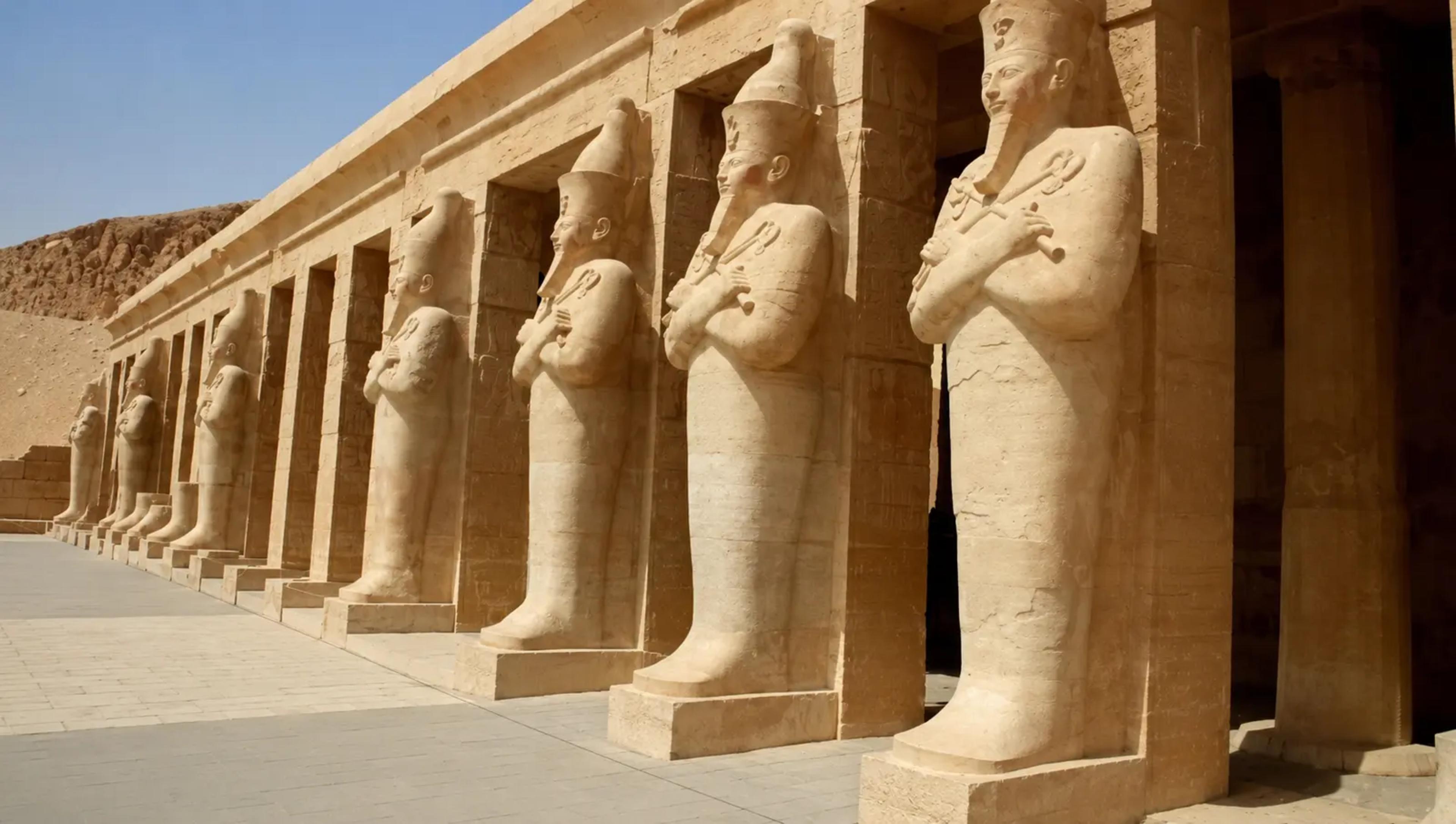
What it is
Deir el-Bahri (the northern monastery — an Arabic name given centuries later by Coptic Christian monks who used the site) is a natural rock amphitheatre on the west bank of the Nile at Luxor, directly opposite Karnak Temple across the river. The centrepiece is the mortuary temple of Hatshepsut, one of Egypt's most significant female pharaohs, known in Egyptological scholarship as Djeser-Djeseru — "Holy of Holies." Built during the 18th Dynasty (c. 1479–1458 BC), the temple was designed by Hatshepsut's chief steward Senenmut and consists of three colonnaded terraces rising against the white limestone cliff face, connected by ramps on the central axis. The site also includes the earlier mortuary temple of Mentuhotep II (11th Dynasty, c. 2055 BC) — Egypt's earliest intact mortuary temple — and the later temple of Thutmose III. The natural peak of El-Qurn is directly above the complex.
Why it matters historically
Hatshepsut's reign — Hatshepsut ruled Egypt for approximately 20 years, first as regent for her stepson Thutmose III and then as pharaoh in her own right; she adopted male royal iconography (false beard, double crown) while her inscriptions sometimes shift between masculine and feminine grammatical forms; the temple is her most complete surviving monument; her funerary equipment and mummy were identified in 2006 through a molar fragment matching a canopic jar in the Egyptian Museum, Cairo
The Punt expedition reliefs — the middle terrace colonnade depicts the famous trading expedition to Punt (a place of contested identification; generally located in the Horn of Africa / Red Sea coast area); the reliefs show the houses on stilts, the exchange of goods, the distinctive physique of the Queen of Punt, and the return voyage laden with myrrh trees, electrum, ebony, and living animals; this is one of the most detailed depictions of a foreign land and trading relationship in New Kingdom art
The erasure campaign — within decades of Hatshepsut's death, her stepson Thutmose III (or later successors) systematically removed her name and image from many surfaces at Deir el-Bahri and Karnak; the motives are debated — political legitimacy, succession narrative, or a later damnatio memoriae campaign; crucially, the erasures were selective and the Punt reliefs survive substantially intact; Thutmose III walled in her obelisks at Karnak rather than destroying them, suggesting the motivation was complex
The Amarna period and later reuse — Akhenaten's agents removed images of Amun from the temple during the Atenist period; the images were later restored, leaving ghost-traces visible on examination; the Romans quarried the lower terrace area; Coptic monks converted parts of the temple complex and gave the site its Arabic name
Senenmut's concealed self-portrait — in a number of temple doorways, small self-portrait graffiti of Senenmut (the temple's architect and Hatshepsut's closest official) were found carved behind door leaves — visible only when the doors were open in antiquity; this is one of ancient Egypt's most striking acts of architectural signature
What to look for
The three-terrace façade — stand at the base of the ramp approach and look up: three colonnaded terraces rise against white limestone; at dawn the cliff reflects pale pink light before the sun reaches the valley floor; the geometry is unlike any other Egyptian temple — horizontal registers rather than pylon-and-forecourt.
The Punt expedition reliefs (middle terrace, south colonnade) — the full panorama of the expedition runs east to west on the south wall; examine the Queen of Punt's figure (her distinctive form is among the most discussed images in Egyptological art history); the myrrh trees shown in their root-balls being transported; the Nile fish species depicted in the water below the boats
The Chapel of Anubis (north end, middle terrace) — well-preserved painted interior; the jackal-headed god presiding over the embalming scene; the blue-and-yellow ceiling; one of the best-preserved painted rooms in the complex
The erasure marks — on the middle terrace north colonnade, look for the rectangular carved recesses where Hatshepsut's cartouches were systematically removed; the limestone surrounding the erasure has a slightly different weathering texture; the ghost of the original name is sometimes still readable
The Mentuhotep II complex (south side) — the earlier Middle Kingdom mortuary temple, partly excavated, sits adjacent; a very different architectural form from Hatshepsut's terraces; the contrast is one of the most direct architectural timelines visible in any single field of view in Egypt; the complex is less visited and quieter
El-Qurn from the terrace — looking west from the upper terrace, the pyramid-shaped summit of El-Qurn is directly above; this view explains the site choice — the pyramid-form was sacred and visible across the Nile from Karnak; the whole west bank necropolis was organized under this natural form
Practical visiting block
Best time to visit: 06:30–09:00 for the light on the terrace face and the absence of coach groups. The approach ramp faces east — morning light rakes across the relief surfaces from the right angle. Midday is bright and the terraces are fully exposed.
Tickets & fees:
Accessibility: The access ramp from the lower terrace to the middle terrace is a gradual incline — manageable for most visitors. The upper terrace involves steps. The inner chapels have uneven stone floors. Not suitable for guests with significant mobility limitations. Sun exposure is considerable on the terraces after 09:00.
Walking distance: Parking/minibus drop to the upper terrace: approximately 400 metres on ramps and path. Total walking for a standard visit: 1–2 km.
Restrooms: Available at the parking area below the temple approach.
Tours that include this site
West Bank Day → /tours/west-bank-day — second major west bank stop after the Valley of the Kings; the site pairing — royal tombs then Hatshepsut's temple — is the foundation of the west bank day
Specialist Day → /tours/specialist-day — extended time with the erasure campaign evidence; comparison between the surviving and defaced sections; Mentuhotep II complex included
Two-Day Luxor → /tours/two-day-luxor — Day 2 afternoon; Hatshepsut's temple as the west bank finale on the second day
Related sites
Valley of the Kings → /luxor/valley-of-the-kings — Hatshepsut's own tomb (KV20) is in the Valley; the temple at Deir el-Bahri and her tomb are the two poles of her mortuary programme
Karnak Temple → /luxor/karnak — Hatshepsut's other major construction site; her two obelisks and the Festival Hall context at Karnak illuminate the scope of her programme; the erased cartouches appear at both sites
Valley of the Queens → /luxor/valley-of-the-queens — visible from the Deir el-Bahri terrace looking south; the same west bank royal landscape