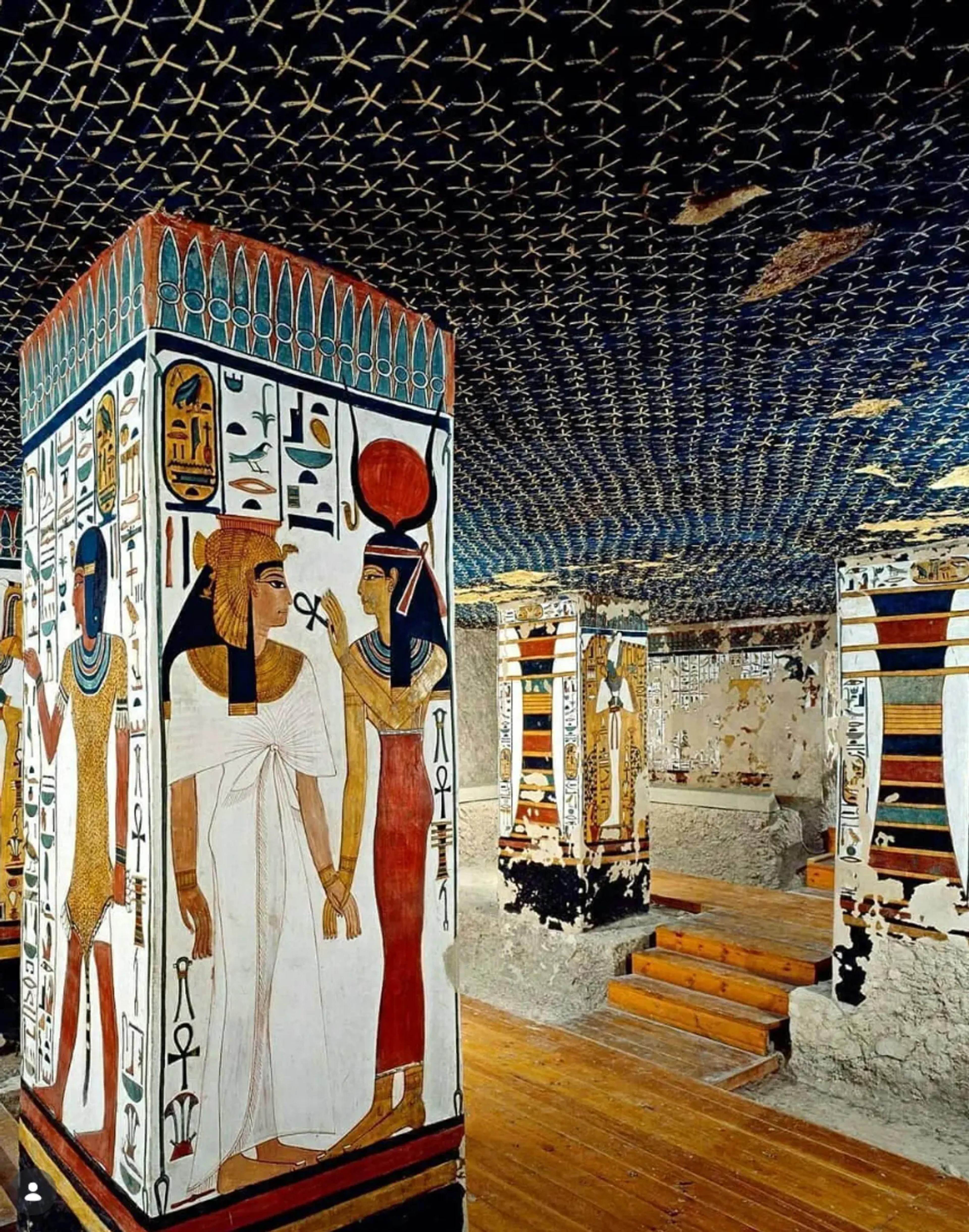
Tomb of Nefertari in 2026
The Tomb of Nefertari in 2026: what has changed, what the ticket covers now, and what to look for in the painted chambers.

Egyptologist Tour Guide, Luxor
Published: · Last updated · 10 min read
Why Nefertari's tomb is different
The designation "Sistine Chapel of Egypt" is overused in travel writing but has a factual basis: the paint quality, the coverage density, and the conservation status are without peer in any royal tomb open to visitors
The technical achievement: raised relief (not just painted plaster) with polychrome paint over it; every figure is both carved and coloured; the blue of the nemes headdress; the white linen of Nefertari herself; the green of Osiris
The scale of the programme: the full Book of the Dead; the Book of Gates; the Opening of the Mouth ceremony; the ceiling of the burial chamber as an astronomical map; this is a complete funerary library executed at the highest known level of New Kingdom artisan skill
The Getty conservation project (1986–1992): what the walls looked like before intervention; what the consolidation of the paint layer involved; why the 30-minute visitor cap exists directly as a result of this work
The access rules in 2026
Daily visitor cap: 150 people per day in groups of no more than 10
Maximum 30 minutes inside the tomb; a guard is present and the time is enforced
Separate ticket, not included in the standard Valley of the Queens admission
Photography policy inside QV66:
My practical advice on tickets: if Nefertari is the reason you are going to the Valley of the Queens, treat the ticket as a booking, not a purchase; high-season availability is limited
What to look for in 30 minutes
The staircase descent: the first 6 metres of the entrance corridor are decorated before the burial chamber; the figures here (Nefertari in white before Ra-Horakhty) establish the quality level immediately
The antechamber (first room): east wall — Nefertari playing senet (the board game) before the gods; this is one of the most distinctive images in the tomb — a queen at leisure in a funerary context
The corridor leading to the burial chamber: Book of Gates scenes; the night barque of the sun; the 12-hour journey format used at Karnak and the Valley of the Kings is here compressed and coloured at its highest expression
The burial chamber ceiling: a night sky of yellow five-pointed stars on an indigo ground; the composition of the ceiling is the strongest argument for the "Sistine Chapel" comparison — it functions as a painted vault
The key figure on the north wall of the burial chamber: Nefertari in white being led by Isis; the queen's face; the delicacy of the brushwork on her wig; the specificity of the jewellery
Using the 30-minute window efficiently: I work through the tomb on a planned route; first the antechamber east wall in detail; then the corridor; then the burial chamber in order; the temptation to photograph everything costs the looking time
What the conservation work tells you
The Getty project documented every square centimetre of the painted surface; the published monograph is available for academic readers
The areas of consolidation are visible on close inspection: a slightly different surface texture where the paint layer was re-fixed; this is not damage but preservation
The pre-restoration photographs (1985–1986) show the walls with significant salt efflorescing through the paint layer; the current condition is substantially better than the unconstrained-access condition
The 30-minute cap is not bureaucratic inconvenience — it is the specific mechanism by which the conservation gain is maintained; CO2 and humidity from visitors is the primary threat to the paint layer now
The comparison with other Valley of the Queens tombs
QV55 (Prince Amunherkhepshef) is included in the standard Valley of the Queens ticket; visiting QV55 immediately after QV66 is the most direct way to understand the quality differential
The comparison is not purely hierarchical — QV55 has its own distinctive qualities, particularly the figures of the young prince; but the artisan allocation is visibly different
This comparison is one of the things I do with specialist guests; it requires time, which is why I include it in the Specialist Day rather than the standard West Bank Day
Related
Tour cross-link: Specialist Day → /tours/specialist-day — the tour structured to include QV66 with enough time to do the comparison visit
Tour cross-link: West Bank Day → /tours/west-bank-day — QV66 available as an add-on with advance arrangement
Encyclopedia cross-link: Valley of the Queens → /luxor/valley-of-the-queens — the full site guide including practical ticket information
About cross-link: /about