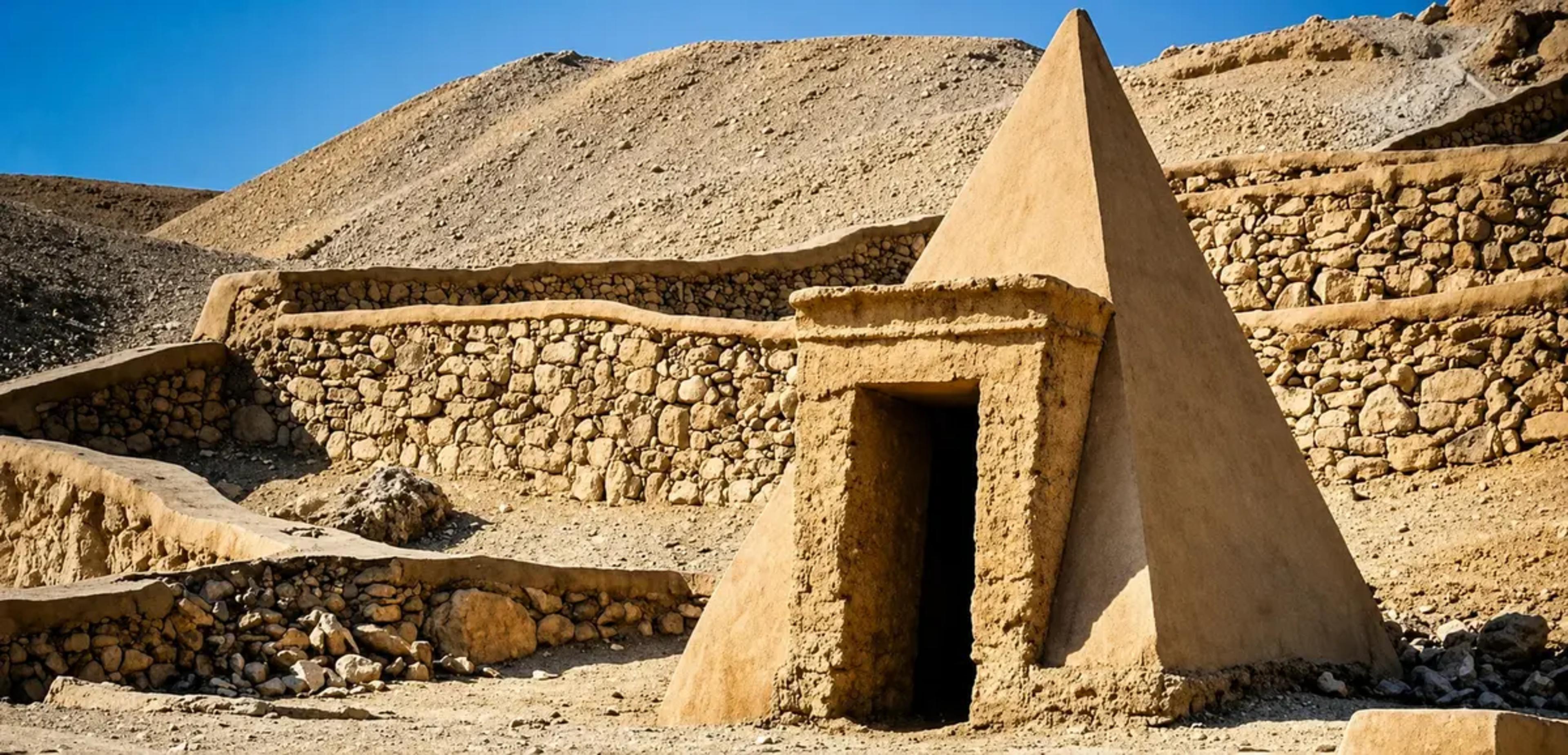
Deir el-Medina is the best-documented community in the ancient world before the modern period. It was a walled village on the West Bank of Luxor, inhabited from the mid-Eighteenth Dynasty (approximately 1550 BCE) to the end of the Twentieth Dynasty (approximately 1070 BCE), by the craftsmen who built and decorated the royal tombs in the Valley of the Kings and the Valley of the Queens. We know these men and their families — not as types or archetypes, but as individuals with names, professions, disputes, debts, love letters, and court records.
Why This Site Is Extraordinary
The combination of excavated village archaeology and an extraordinarily well-preserved papyrus record makes Deir el-Medina unique in Egyptology. The village was abandoned at the end of the New Kingdom, after which it became a monastery (hence the Arabic name Deir el-Medina — 'Monastery of the Town'). The dry desert environment preserved organic materials that would have decayed elsewhere.
The ostraca — limestone chips and pottery fragments used as writing surfaces — are the most numerous documentary record. Thousands of them have been found, covering tomb work schedules, ration records, complaints about missing rations, love poetry, medical prescriptions, and what appear to be the first documented labour strike in history. In the reign of Ramesses III, the workers of Deir el-Medina laid down their tools and marched to the mortuary temples to demand their overdue grain rations. The event is recorded on papyrus now in the Egyptian Museum.
The Village
The village itself covers approximately 1,200 square metres — a small, densely packed settlement of connected houses built against the valley walls. The houses were mudbrick, with limestone foundations in some cases, and typically consisted of an entrance hall, a living room, a bedroom, and a cellar for storage. The walls were sometimes plastered and painted. The site was excavated primarily by the Institut Français d'Archéologie Orientale (IFAO) between 1917 and 1947 under Bernhard Bruyère, whose meticulous documentation remains the foundational reference for the site.
Walking through the excavated foundation walls today, it is possible to trace the layout of individual houses and to understand the social geography of the village — which families lived near the entrance, which were in the centre, which were near the community chapel at the southern end. The space is small. These were people who lived at very close quarters for generation after generation.
The Tombs
The craftsmen of Deir el-Medina built their own tombs in the low hills surrounding the village. These are not royal tombs — they are small, private sepulchres — but the people who decorated them were the finest craftsmen in Egypt. The result is some of the most accomplished tomb painting in the Theban necropolis, comparable in quality to the best of the Nobles' tombs and in some cases superior.
The Tomb of Sennedjem (TT1) is one of the most visited and most remarkable. The main chamber is completely painted, ceiling included, with scenes of the afterlife that include the famous image of Sennedjem and his wife Iyneferti working in the Fields of Yaru — the Egyptian paradise, depicted here as an idealised version of the Nile delta, with wheat growing taller than the people harvesting it. The composition has a clarity and warmth that is unusual in tomb art, which tends toward the formal and hieratic.
The Tomb of Inherkhau (TT359) contains the famous scene of a blind harpist — one of several surviving versions of this image from the New Kingdom — along with colourful scenes of the deceased and his family in the presence of the gods. The tomb is smaller than Sennedjem's but the painting quality is exceptional, and the colours have survived in particularly good condition.
The Ptolemaic Temple
In the northern part of the site stands a small Ptolemaic temple, built in the third and second centuries BCE and dedicated to Hathor and Maat. It is not the most architecturally dramatic temple in Luxor, but it is significant for two reasons: first, it was constructed directly over a New Kingdom well and incorporated earlier votive objects, making it a site of continuous religious activity spanning more than a thousand years. Second, the relief carvings inside are in extremely good condition — the Ptolemaic period had high standards of relief carving and the protected location of Deir el-Medina has preserved them well.
Practical Visiting Notes
Deir el-Medina is approximately four kilometres south of the main West Bank ticket office and is typically reached by taxi or microbus from the ferry landing. It is usually quieter than the Valley of the Kings and the Valley of the Queens, which makes it one of my preferred destinations for clients who want to spend time actually looking rather than moving through a crowd.
The site requires a separate ticket from the Valley of the Queens, though combination tickets are sometimes available — confirm at the ticket office. Access to individual tombs requires specific tomb tickets. Opening hours are typically 6 a.m. to 5 p.m. Tours that include this site: the West Bank Day tour can be configured to include Deir el-Medina; the Specialist Day tour regularly includes it for clients with historical or archaeological interests. I also include it as a specific focus for clients who are interested in the human texture of ancient Egyptian life rather than the monumental scale.