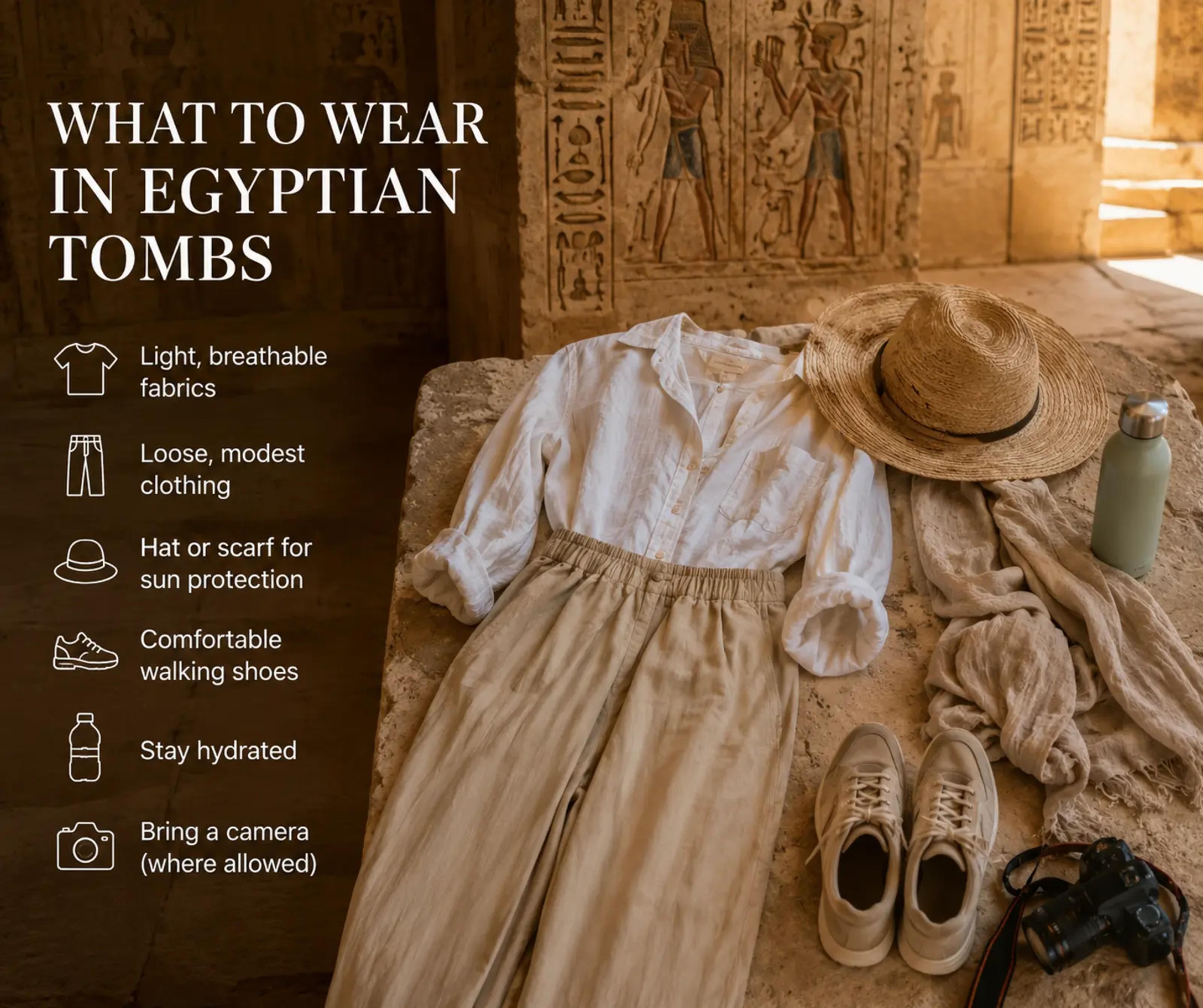
What to wear in Egyptian tombs
What to wear in Egyptian tombs — and why it matters more than you think. Practical guidance from a guide who has taken thousands of visitors underground.

Egyptologist Tour Guide, Luxor
Published: · Last updated · 5 min read
The two environments you are dressing for
The valley floor / approach to the tomb: full sun exposure, reflective limestone, typically 25–40°C depending on season; you will be outside for 20–40 minutes between tombs
Inside the tomb: constant temperature year-round of approximately 20°C (68°F); cool, still air; often noticeably dim; no humidity
The outfit problem: what is comfortable outside (lightweight, minimal) is occasionally chilly inside; the practical answer is layering that works for both in a short transition
What to wear: the list
Footwear: Closed-toe shoes with a rubber sole; walking shoes or light trainers; NOT sandals, flip-flops, or heels; the tomb entrance ramps are steep cut limestone, often worn smooth; wet conditions after rain (rare but possible) make open shoes treacherous; some tombs require ducking and you do not want to lose footing
Trousers / lower body: Lightweight long trousers or convertible trousers preferred; the limestone tomb walls are rough and the entry corridors are narrow; bare skin against rough stone produces abrasions; long trousers also cover modestly at temple sites; linen or technical travel fabric are both appropriate
Upper body: A lightweight long-sleeved shirt or a light layer you can remove; shoulders should be coverable (temples and some chapel areas have signage requesting covered shoulders); the sun exposure outside is significant enough that bare arms accumulate UV fast between tombs
Hat: Wide-brimmed sun hat mandatory for the valley floor; a fabric bucket hat is the practical choice (crushable, packable, stays on in wind); baseball caps do not cover the neck
Scarf / light wrap: Doubles as shoulder coverage at temple sites and as a head covering if desired; light cotton or linen; neutral colour preferred (white reflects heat)
Sunglasses: Essential on the valley floor; the reflected light off white limestone is intense
What NOT to wear
Open footwear of any kind: Not sandals, not Birkenstocks, not flip-flops; the descent ramps inside tombs are the reason; guests who arrive in sandals can sometimes borrow from me but I cannot guarantee this
Shorts inside tombs: Not prohibited in most locations, but the limestone wall contact issue is real; I recommend against shorts for this reason, not modesty
Tight or restrictive clothing: Some tomb corridors require sideways movement; very narrow jeans or fitted skirts restrict movement on steep descending ramps
White or pale fabrics near temple walls: The limestone dust is pale and transfers; it will not ruin clothing but will show; sand-coloured or medium-toned clothing is practical
Heavy bags or wide backpacks: The inner chambers of some tombs require narrow single-file passage; large backpacks make this difficult and can damage wall surfaces on contact; a small day bag carried in front is better
Mobility-specific advice
Cane or walking pole: Permitted; useful on the ramp descents; notify me at the start of the day so I can plan the route and the pace
Knee support: Several tombs have steep descending ramps that put strain on the knees; if you have knee concerns, compression sleeves and the right footwear make a significant difference
The heat factor: Hyperthermia risk is real in summer (May–September) on the valley floor; I adapt the schedule — fewer tombs, longer rest intervals, earlier end-time; any guest who tells me they are heat-sensitive at the start of the day gets a different programme than what is on the page
"I would rather change the itinerary than manage a heat emergency."
What time of year changes the advice
October–April (high season): Comfortable 20–28°C valley floor temperatures; the outfit above is comfortable; a light fleece or jacket for the early morning is useful before sunrise warmth arrives
May–September (low season / summer): 35–45°C on the valley floor; I start the Valley of the Kings visit at 06:00 and aim to be back in the car by 09:30; the tomb interiors remain cool; the clothing advice is the same but the early start is non-negotiable
December–February: Mornings can be cool to cold on the west bank (15–20°C); the inside-outside temperature differential is reversed; have a layer for outside in the morning
Practical packing checklist
Closed-toe walking shoes
Lightweight long trousers
Light long-sleeved top (or short-sleeve + scarf)
Wide-brimmed hat
Sunglasses
1.5 litre water minimum (I supply water on all tours, but having your own is always wise)
Small day bag (front-carried)
Optional: thin fleece for early starts in winter
Related
Tour cross-link: West Bank Day → /tours/west-bank-day — the full west bank itinerary this article prepares you for
Tour cross-link: Family Day → /tours/family-day — mobility-aware logistics including clothing for mixed-age groups
Encyclopedia cross-link: Valley of the Kings → /luxor/valley-of-the-kings — the site the clothing advice is most relevant to
About cross-link: /about