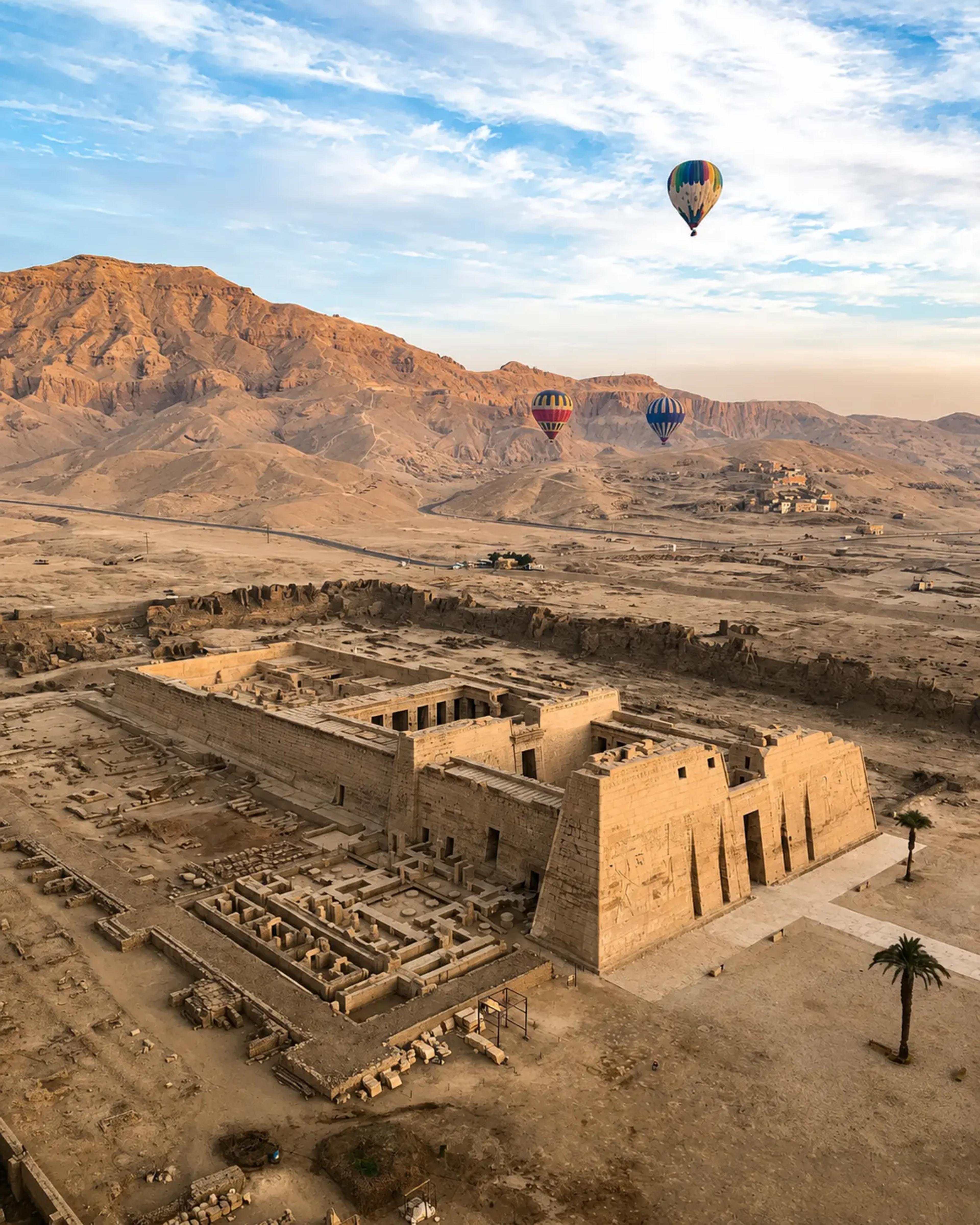
The five reliefs at Medinet Habu most travellers miss
Five reliefs at Medinet Habu most travelers walk past — and what each one is actually showing.

Egyptologist Tour Guide, Luxor
Published: · Last updated · 10 min read
Why Medinet Habu is under-visited
The location: southernmost of the main west bank sites; most tour itineraries include it as the last stop, when time and energy are already spent; I schedule it differently — as the first or second stop when it is the point of the day
The preservation paradox: precisely because it is the best-preserved major temple on the west bank, the detail density can be overwhelming without a framework for looking; without that framework, visitors see walls of hieroglyphs and move on
The standard tour behaviour: groups spend 45–60 minutes walking the courts and the pylon; the outer walls are rarely approached; the Amun chapel and the migdol upper rooms are often skipped entirely
This article is a framework for the five specific things I stop at with every specialist guest
Relief 1: The naval battle (outer north wall)
Location: the outer north wall, east section; reached by walking around the outside of the main precinct
What it shows: the sea engagement between Egyptian forces and the Sea Peoples in Year 8 of Ramses III's reign; the Egyptian ships (higher in the composition) have archers firing from the rigging; the Sea Peoples vessels are below and to the right; warriors are shown falling into the water
What makes it significant: this is the only surviving ancient depiction of a naval battle in Egyptian art; the ship construction details — rigging, oar configuration, hull shape — are the primary archaeological evidence for Late Bronze Age Mediterranean seafaring technology
How to look: stand far enough back to read the full composition register (approximately 15 metres); then approach for the detail of the individual fallen warriors and the rope-binding scenes
Relief 2: The royal hunt (second court, south wall)
Location: inner south wall of the second court; accessible on the standard ticket route
What it shows: Ramses III hunting wild bulls and lions; the animals are shown in three registers — living and fleeing at left, captured in centre, killed at right; the composition reads as a sequential narrative from left to right
What makes it significant: the naturalism of the animal figures is markedly different from the hieratic rigidity of the human figures in the same relief; the bull in mid-flight and the lion in mid-spring are kinetic in a way rarely seen in New Kingdom public art; the royal hunt was a ritual act confirming sovereignty — the iconography is specific to this meaning
How to look: trace the hunting sequence from left to right; examine the bull's hindquarters in the mid-flight figure — this is among the most naturalistic single animal figures in Egyptian relief carving
Relief 3: The festival calendar (inner rooms, hypostyle hall east wall)
Location: the inner hypostyle hall, east wall; requires entering the main temple building
What it shows: a carved calendar of religious festivals, offerings, and processional dates; the calendar runs in registers from top to bottom; the offerings for each festival are itemised; the officiants are identified by title
What makes it significant: this is one of the most complete ancient Egyptian festival calendars surviving; it is the primary source for understanding the rhythm of the New Kingdom religious year at Thebes; the administrative specificity — quantities of bread loaves, jars of beer, cuts of meat — is the kind of detail that exists nowhere else in this form
How to look: this requires artificial light or a strong torch; the register structure is the key — horizontal strips, each representing a festival period; look for the consistent format: date, festival name, offering list, officiants; once the pattern is visible, the scale of the record becomes legible
Relief 4: The harem conspiracy text (inner chambers, south section)
Location: inner south chambers, accessible with the main ticket; sometimes requires a guard to unlock the room
What it shows: a text recording the conspiracy by members of Ramses III's harem to assassinate the pharaoh and replace him with a lesser son; the text names the conspirators and lists the charges; the trial and punishment are detailed elsewhere in the Turin Judicial Papyrus (Cairo)
What makes it significant: this is one of the most complete surviving accounts of a political assassination attempt in ancient Egypt; the Medinet Habu text and the Turin papyrus together constitute one of the most detailed legal records from the ancient world; the guest who knows the Turin papyrus context can read the Medinet Habu text in conversation with it
How to look: the text requires some Egyptological preparation to read meaningfully; I give guests the narrative framework before entering the room; the value is the physical encounter with the primary source, not the ability to read Middle Egyptian
Relief 5: The Amun chapel colour (early Thutmose III section)
Location: the small temple within the complex, predating Ramses III; accessible from the north side of the main precinct
What it shows: the inner sanctuary of the earlier Amun chapel retains original polychrome paint at levels uncommon in larger temple spaces; red, green, yellow, and black pigment on white limestone; the ceiling is intact with painted astronomical details
What makes it significant: the colour survival here is a direct result of the later Ramses III structure being built around it, protecting the inner rooms from weathering and salt intrusion; this is the best single example in the west bank — outside of QV66 — of what New Kingdom paint looked like at the moment of completion
How to look: allow 10–15 minutes of eye adjustment; the chapel is dim; the colours become more readable as the eye adapts; look at the lower register figures first, then the ceiling
How to do this in a morning
Sequence: north outer wall (naval battle) → second court south wall (royal hunt) → inner hypostyle calendar → inner south chambers → Amun chapel colour
Time budget: 20–25 minutes per stop; 2–2.5 hours total for the five-stop itinerary
This is the Specialist Day programme at Medinet Habu; on the West Bank Day I include stops 1, 2, and 5 and skip the calendar and harem text for time
"The difference between a 45-minute Medinet Habu visit and a 3-hour one is not the same site seen for longer — it is a qualitatively different experience of the same walls."
Related
Tour cross-link: Specialist Day → /tours/specialist-day — the tour that includes the full five-stop Medinet Habu itinerary described here
Encyclopedia cross-link: Medinet Habu → /luxor/medinet-habu — the full site guide
About cross-link: /about